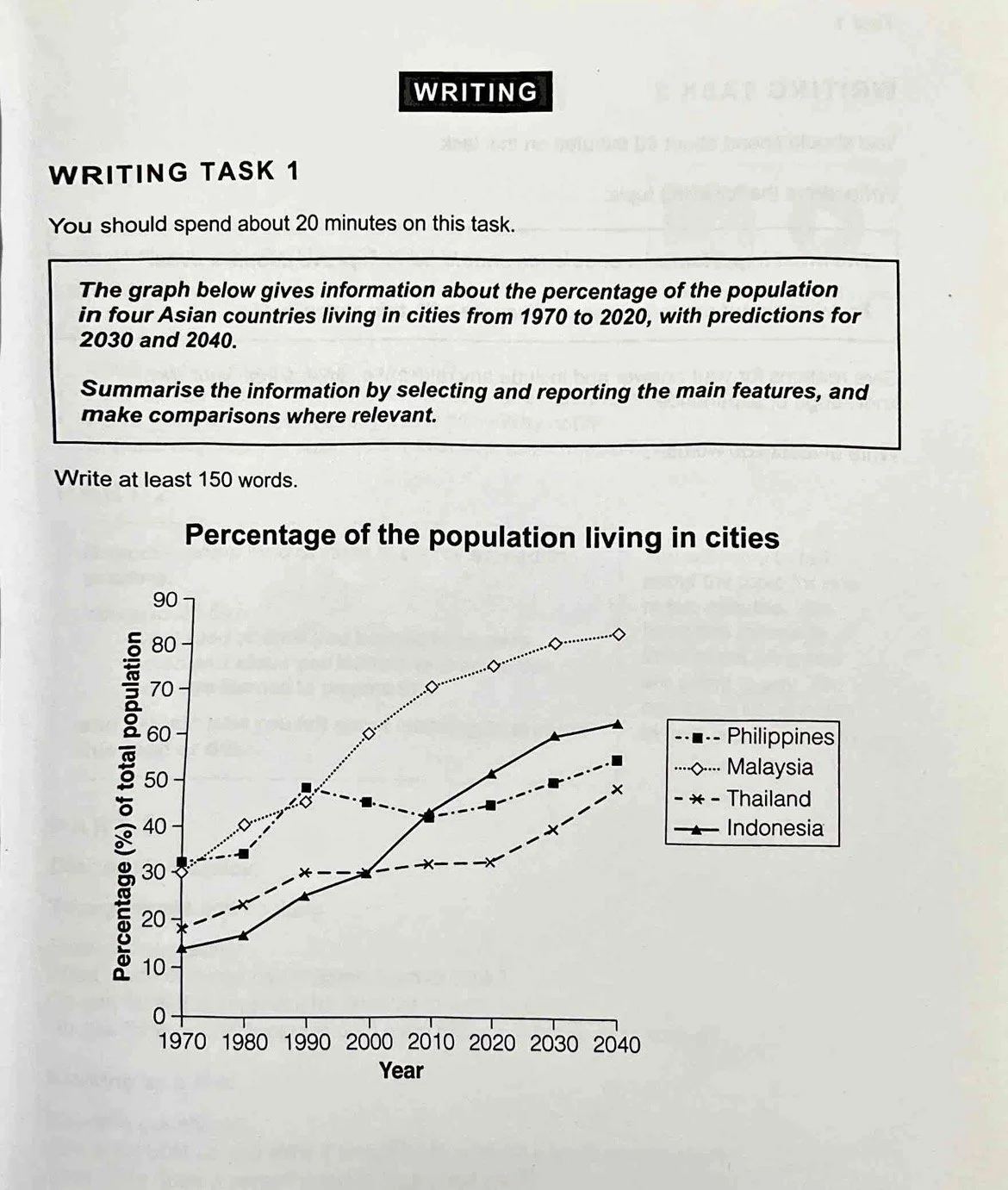
The graph provides information regarding the percentage of the population living in urban areas in four Asian countries (the Philippines, Malaysia, Thailand, and Indonesia) from 1970 to 2020, with predictions extending to 2030 and 2040.
Overall, it is clear that all four nations are projected to experience an increase in urbanization over the 70-year period. Malaysia is expected to consistently have the highest proportion of city dwellers, while Thailand is predicted to have the lowest for the majority of the timeline.
Looking at the details, both Malaysia and the Philippines showed striking parallels between 1970 and 1990. Starting at around 30% and 31% respectively, Malaysia’s urban population grew to 45% by 1990, while the Philippines climbed to nearly 48%. Remarkably, from 1990 to 2020, Malaysia experienced sharp growth to about 74%, followed by a slighter upward trend predicted to reach over 80% by 2040. By contrast, the percentage in the Philippines dipped to around 42% in 2010 before steadily climbing toward a projected 54% in 2040.
Meanwhile, Thailand and Indonesia began at approximately 18% and 14% respectively, and their figures intersected at about 29% in the year 2000. Following this, Indonesia showed a steady upward trend that is expected to continue until 2040, reaching roughly 60%. Conversely, Thailand’s urban population remained largely unchanged between 2000 and 2020, though it is forecasted to see a sudden increase to about 48% by 2040.